
Lattice GAL22V10D-15QJ: Architecture, Features, and Key Applications
The Lattice GAL22V10D-15QJ stands as a classic and highly influential device in the history of programmable logic. As a member of the Generic Array Logic (GAL) family, it provided a powerful, erasable, and pin-compatible replacement for a wide array of simple PAL devices, revolutionizing digital design in the late 1980s and 1990s. Its architecture, speed, and flexibility made it a cornerstone for countless applications.
Architecture: A Look Inside
The GAL22V10D-15QJ is built around a programmable AND array feeding into a fixed OR array, a structure known as a Sum-of-Products (SoP) logic fabric. The key to its versatility lies in its Output Logic Macrocell (OLMC). The device features 12 dedicated inputs and 10 output macrocells, which can also be configured as inputs, offering up to 22 total inputs (hence the '22' in its name). The '10' denotes the number of these macrocells.
Each OLMC is incredibly flexible. It can be individually configured by the designer to be:
A dedicated combinatorial output.
A registered output (with a D-type flip-flop).
A combinatorial or registered I/O pin.
A dedicated input pin.
This programmability is managed through a global architecture control word and individual macrocell control bits. The programmable AND array contains the fusible links that define the user's specific logic functions, while the fixed OR array combines the product terms.
Key Features and Specifications
The part number itself reveals critical specifications:
GAL22V10: Denotes the family and configuration.
D: Indiates the plastic dual-in-line (DIP) package.
-15: Signifies a maximum propagation delay of 15 nanoseconds, making it a high-speed solution for its era.
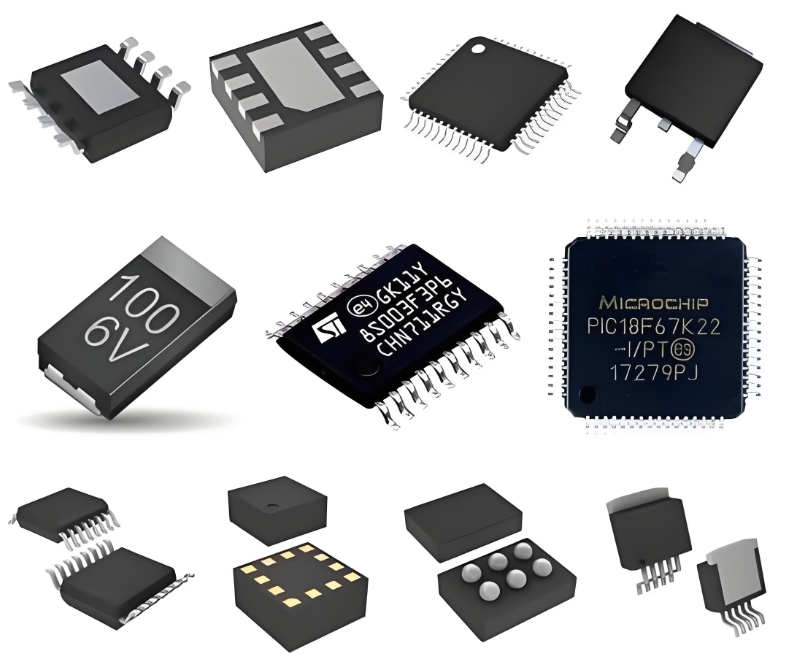
QJ: Often relates to the package type (e.g., PLCC) and temperature grade (Commercial).
Its most significant feature was electrically erasable (E²) CMOS technology. Unlike one-time programmable (OTP) bipolar PALs, the GAL22V10D could be reprogrammed and erased thousands of times using a standard programmer, drastically accelerating design iteration, prototyping, and debugging. It also featured an integrated security bit to prevent unauthorized copying of the programmed logic pattern.
Key Applications
The GAL22V10D-15QJ found widespread use as a "glue logic" device, integrating multiple simple TTL or CMOS chips into a single, customizable package. Its primary applications included:
1. Address Decoding and Memory Mapping: In microprocessor systems (e.g., based on 68000 or 8086 families), it was perfect for generating chip-select signals for RAM, ROM, and peripherals.
2. State Machine Design: Its registered outputs were ideal for implementing medium-complexity finite state machines (FSMs) for control logic.
3. Bus Interface Logic: It was commonly used for implementing bus arbitration, wait-state generation, and data bus buffering control.
4. I/O Port Expansion and Control: It could manage data transfer between peripherals and a central CPU, implementing custom parallel interfaces.
5. Function Integration: It replaced multiple small- and medium-scale integration (SSI/MSI) logic gates (e.g., counters, decoders, latches) with a single, compact chip, reducing board space, power consumption, and part count.
ICGOODFIND: The Lattice GAL22V10D-15QJ was a transformative workhorse of digital design. Its reprogrammable E²CMOS technology, flexible output macrocells, and high 15ns speed empowered a generation of engineers to efficiently consolidate complex glue logic, accelerate prototyping, and create more reliable and integrated systems. While largely superseded by more complex CPLDs and FPGAs today, its architectural principles remain foundational.
Keywords:
Programmable Logic Device (PLD)
Generic Array Logic (GAL)
Output Logic Macrocell (OLMC)
Glue Logic
E²CMOS Technology

